
Vietnam War · A-6A Intruder · Alive and free on the ground for three days · Unaccounted for
He ejected from a burning A-6A with a badly broken left leg, talked to rescue aircraft for three days, and was never seen again. His pilot came home after nearly six years in Hanoi and spent the rest of his life asking what happened to him. The Vietnamese say he was shot dead and buried. The grave they identified was empty.

The man
James Kelly Patterson grew up in Long Beach, Calif., obsessed with flying; he painted jets and hung model bombers from his bedroom ceiling. A month before he was lost, he spent a day on patrol with his brother George, a Marine rifle platoon leader, talking about home and family — “as it turned out our final, hours together,” George wrote. (POW Network, pownetwork.org; wording Unconfirmed by PIP.)
What is known
- Born 14 July 1940 at South Pasadena, California, a Navy junior. U.S. Naval Academy class of 1963. He failed the flight physical at graduation and later qualified for flight training.
- Naval flight officer, Attack Squadron 35, aboard USS Enterprise. Awarded the Distinguished Flying Cross for a mission of 10 April 1967 flown, in the citation’s words, “at dangerously low altitude” over North Vietnam.
- On 19 May 1967 he was the bombardier-navigator of an A-6A Intruder, bureau number 152594, call sign “Raygun Three,” flown by Lt. Cmdr. Eugene “Red” McDaniel, against a truck repair facility at Van Dien. The aircraft was hit by a surface-to-air missile at about 1112 hours. Both men ejected, landing roughly a mile apart. McDaniel injured his back. Patterson broke his left leg badly on landing.
- He was carried as a lieutenant at the time of the loss and promoted to lieutenant commander while missing.
- He is memorialized on the Courts of the Missing at the National Memorial Cemetery of the Pacific and on the Vietnam Veterans Memorial in Washington.
- The Defense POW/MIA Accounting Agency today carries him as unaccounted for, in its analytical category of Active Pursuit.
Three days on the ground
Squadron mates located both men alive on 19 May. On 20 May searchers found Patterson again, alive and still free. On 21 May an Air Force F-4 crew spotted him and dropped a Fulton extraction kit. By radio he reported that enemy troops had taken his survival kit and that he had moved uphill for safety. The last contact was the evening of 21 May 1967. Rescue efforts were terminated the following day.
Accounts differ on the length of that period and on what ended it. The Defense POW/MIA Accounting Agency says the final contact was on 21 May and that he “was never reported as a prisoner of war.” Task Force Omega records that he was captured on 22 May 1967 and that he was carried as a prisoner of war from that date. PIP records the conflict rather than choosing between the two.
The loss location is given three ways in the public record: Van Dien, North Vietnam, without a province, by the Defense POW/MIA Accounting Agency; Van Dien in Hai Duong Province by the Naval Academy’s memorial register and by POW Network; and the Van Dien district of Hanoi by Task Force Omega. This matters, because where he came down governs which local witnesses and which provincial records are the right ones to ask for.
What returning prisoners said
McDaniel was captured and held nearly six years, and asked about his back-seater throughout. He was given conflicting answers. One guard told him that Patterson’s injury had healed and that he was well. A second returned prisoner, Col. Dewey Smith, reported seeing Patterson’s name on an interrogation questionnaire at a prison facility.
McDaniel’s own conclusion is reported two ways and both are on the record. POW Network states that he eventually concluded his back-seater had died. Reporting at the time of McDaniel’s death in August 2026 states that he believed Patterson may have been transferred to the Soviet Union. The two are not necessarily inconsistent across nearly sixty years, but PIP does not know which view he held at the end, and does not claim to.
The Vietnamese account, and the empty grave
In 1985 North Vietnam said that militia had found Patterson dead in the jungle after a gunfight and had buried him. Written reports supplied over the following years gave conflicting details of the death. In December 1990 four witnesses were produced who said they had found him, shot him and buried him, and that the body had since disappeared through bombing, animals or a stream.
In May 1992 a joint United States and Vietnamese team excavated the site the Vietnamese had identified. Task Force Omega records that the excavation “found no trace of remains” and that the soil showed no disturbance. The account preserved by POW Network is blunter: the team found “only undisturbed soil strata. No bones, no teeth, not a zipper, button, or buckle.”
He was carried as a prisoner of war in 1973 and later reclassified as killed in action, body not recovered. He is nevertheless carried today as unaccounted for and in Active Pursuit. We have not found anything published that says what moved the case from one state to the other.
The Soviet claim
A separate line of inquiry, pursued for three decades by the researcher William Newman and by Patterson’s brother George “Luck” Patterson, holds that he survived capture and was moved to the Soviet Union for what he knew about the A-6’s electronics, which were then being flown against Soviet-designed air defenses.
- In 1991 the Moscow journalist Yuri Pankov is reported to have written that an American “second pilot” shot down on 19 May 1967 was taken overland through a gap in the China–Soviet border to Saryshagan on Lake Balkhash, in Kazakhstan — the Soviet air-defense and anti-ballistic-missile test range.
- In 1997 a professor in Kazakhstan is reported to have said that Patterson worked at a secret arms facility at Saryshagan on Lake Balkhash. A witness in Kazakhstan who said she had met Patterson at a Soviet military facility later changed her account when United States investigators questioned her.
- The wider context is the 1972 Soviet document known as 1205 and Gen. Dmitri Volkogonov’s references to KGB approval of intelligence exploitation — both already part of PIP’s record.
None of this is established. PIP has not seen the Pankov article in the original, has not identified the Kazakh professor, and does not know on what basis the witness changed her account. It is set out here because it is testable, not because it is proved.
His brother’s account
His brother Luck Patterson, a Family Adviser to the POW Investigative Project, has pursued the case for decades. He says the photograph below is the one published in two newspapers in Alma-Ata, Kazakhstan, about 1995. It drew a woman who said she had met Kelly face to face at Priozersk, Kazakhstan, in late 1967, when she was 13. She was certain it was him, Luck Patterson says, but would not identify herself out of fear for herself and her son. He flew to Alma-Ata in 1997 and appeared in local news media to try to draw her out, without success. She later said her half-brother told her Kelly had died in an automobile accident in Moscow.
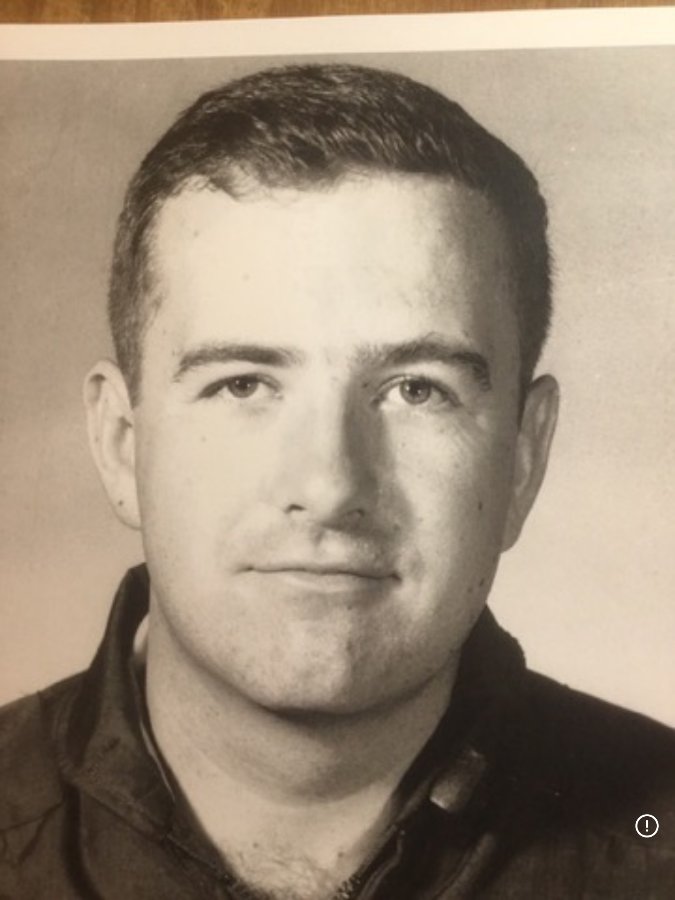
Luck Patterson believes his brother, who evaded for three days with a badly broken leg, was taken alive to Kazakhstan so Soviet specialists developing weapons systems there could question him. He says he has no reason to believe Kelly had any knowledge of nuclear weapons or delivery systems. He believes Kelly was then either executed or turned over to Kazakh authorities, and may have been moved elsewhere in Soviet Central Asia, and he has not given up on finding him or his grave. The Defense POW/MIA Accounting Agency profile does not mention the Kazakhstan reporting.
He also shared a photograph of himself as he looked in 1967, the face his brother would remember, in the hope that Kelly, if he is alive, might see it and recognize him.

What remains unresolved
- Was he captured? Task Force Omega records a capture on 22 May 1967 and a prisoner-of-war listing from that date. The Defense POW/MIA Accounting Agency says he was never reported as a prisoner of war. Both statements are in the public record and they cannot both be right.
- What happened between the reclassification to killed in action, body not recovered, and his present listing as unaccounted for and in Active Pursuit? Whatever reopened the case is a document, and if it has been released, we do not have it.
- Where did he come down? Three different locations are published for the same loss.
- Why did the excavation of a grave the Vietnamese themselves identified find undisturbed soil?
- Is there an original of the 1991 Pankov report, and does it say what it is said to say?
- Who was the Kazakh professor of 1997, and what became of the witness who changed her account?
Why the case matters
A man was alive, free and talking to American aircraft three days after his aircraft was destroyed. The enemy knew where he was; they had already taken his survival kit. The government that held that ground later produced witnesses, a story and a grave, and the grave was empty. That is the pattern PIP documents across three wars: an account offered, accepted and never tested against the ground.
The Soviet element makes it more than a Vietnam case. If a specialist in the electronics of a front-line American attack aircraft was moved out of North Vietnam, the mechanism is the same one the project has documented for Korea and for the Cold War shoot-downs. That is why this case sits alongside the others here and not on its own.
Evidence and sources
- Defense POW/MIA Accounting Agency, service member profile for Lt. Cmdr. James Kelly Patterson — loss narrative, unit, aircraft, status and analytical category. Read 7 September 2026.
- U.S. Naval Academy Virtual Memorial Hall, LCDR James K. Patterson, USN — birth, class, Distinguished Flying Cross, the search, and family.
- POW Network biography, Patterson, James K. — the guard’s remark to McDaniel, Col. Dewey Smith and the interrogation questionnaire, the 1985 Vietnamese account, and the excavation result.
- Task Force Omega, carried by Rolling Thunder Remembered — the mission, the surface-to-air missile hit at 1112, the day-by-day search, the December 1990 witnesses, the May 1992 excavation, and the Pankov and Kazakhstan reports.
- prisoner-of-war.com, “Moscow Bound?”, maintained by William Newman — the Soviet-transfer argument in full.
- The Zebra, Alexandria, 14 August 2026, and the Everly Wheatley obituary — for Capt. McDaniel’s death and his POW/MIA work.
Research assisted by artificial intelligence. Where sources conflict, this page records the conflict and does not resolve it.
Request for information
Please contact us if you can help with any of the following.
- Accounts from anyone who saw Patterson alive after May 1967, from his capture to the route north.
- Information on his reported removal from Vietnam by Soviet transport and on his time in Kazakhstan, including at Saryshagan or Priozersk.
- The woman who said she met him in Priozersk when she was 13, or her family.
He was alive and free for three days, and the enemy had his survival kit. The grave Vietnam produced held only undisturbed soil. Did militia kill him, as Hanoi says? Or was an A-6 bombardier-navigator taken to the Soviet Union for what he knew about the aircraft’s electronics? If so, did he die there, or live on in Central Asia?
Write to contact@powinvestigativeproject.org, in English or another language.
Українська
Лейтенант Джеймс «Келлі» Паттерсон, ВМС США — зник безвісти, В’єтнам, травень 1967 року
Збитий 19 травня 1967 року, Паттерсон підтримував зв’язок з американськими силами щонайменше до 21 травня. Востаннє його бачили живим поблизу села Донг Дань, община Тхионг Тхієн, повіт Кім Бой, провінція Хоа Бінь. Під час захоплення він мав перелом ноги. Його посвідчення особи та картку Женевської конвенції В’єтнам повернув у 1985 році.
Пізніші повідомлення вказували, що Паттерсона радянські представники вивезли до військового науково-дослідного об’єкта в місті Пріозерськ (Казахстан), який тоді входив до складу СРСР. Російські офіційні особи це заперечують.
Ми особливо шукаємо жінку, якій у 1968 році було 13 років і яка зустріла Паттерсона в Пріозерську. За її словами, її зведений брат, радянський офіцер, привів його до їхнього дому, і Паттерсон подарував їй ляльку. У 1994 році вона анонімно розповіла про це телефоном професору Коломійцю в Алма-Аті. Її так і не було встановлено.
Також шукаємо: свідків його захоплення чи поховання у В’єтнамі; фотографії, нібито зроблені в’єтнамськими посадовцями після захоплення; тих, хто перевозив його до Ханоя або охороняв у в’язниці; лікарів, які лікували його ногу; свідків — в’єтнамських або російських — які бачили, як його вивозили російським транспортом; російських учасників перевезення до Казахстану; родину або самого Владислава Тімашова, колишнього майора Першого головного управління; громадян Росії чи Казахстану, які бачили його в Алма-Аті, Саришагані або Пріозерську.
Війна давно скінчилася. Родина шукає лише відповідь. Напишіть нам: contact@powinvestigativeproject.org
Русский
Лейтенант Джеймс «Келли» Паттерсон, ВМС США — пропал без вести, Вьетнам, май 1967 года
Сбитый 19 мая 1967 года, Паттерсон поддерживал связь с американскими силами по меньшей мере до 21 мая. В последний раз его видели живым близ деревни Донг Дань, община Тхыонг Тхиен, уезд Ким Бой, провинция Хоа Бинь. При захвате у него была сломана нога. Его удостоверение личности и карточку Женевской конвенции Вьетнам вернул в 1985 году.
Более поздние сообщения указывали, что Паттерсона советские представители вывезли на военный научно-исследовательский объект в городе Приозёрск (Казахстан), тогда входивший в состав СССР. Российские официальные лица это отрицают.
Мы особенно ищем женщину, которой в 1968 году было 13 лет и которая встретила Паттерсона в Приозёрске. По её словам, её сводный брат, советский офицер, привёл его к ним домой, и Паттерсон подарил ей куклу. В 1994 году она анонимно рассказала об этом по телефону профессору Коломейцу в Алма-Ате. Её личность так и не была установлена.
Также ищем: свидетелей его захвата или захоронения во Вьетнаме; фотографии, предположительно сделанные вьетнамскими должностными лицами после захвата; тех, кто перевозил его в Ханой или охранял в тюрьме; врачей, лечивших его ногу; свидетелей — вьетнамских или российских — видевших, как его вывозили российским транспортом; российских участников перевозки в Казахстан; семью или самого Владислава Тимашова, бывшего майора Первого главного управления; граждан России или Казахстана, видевших его в Алма-Ате, Сарышагане или Приозёрске.
Война давно закончилась. Семья ищет только ответ. Напишите нам: contact@powinvestigativeproject.org
Update history
- 7 September 2026 — page created, following the death of Capt. Eugene “Red” McDaniel and PIP’s check of the current Defense POW/MIA Accounting Agency record.
Sept. 16, 2026: Merged with a second PIP page on Patterson.